


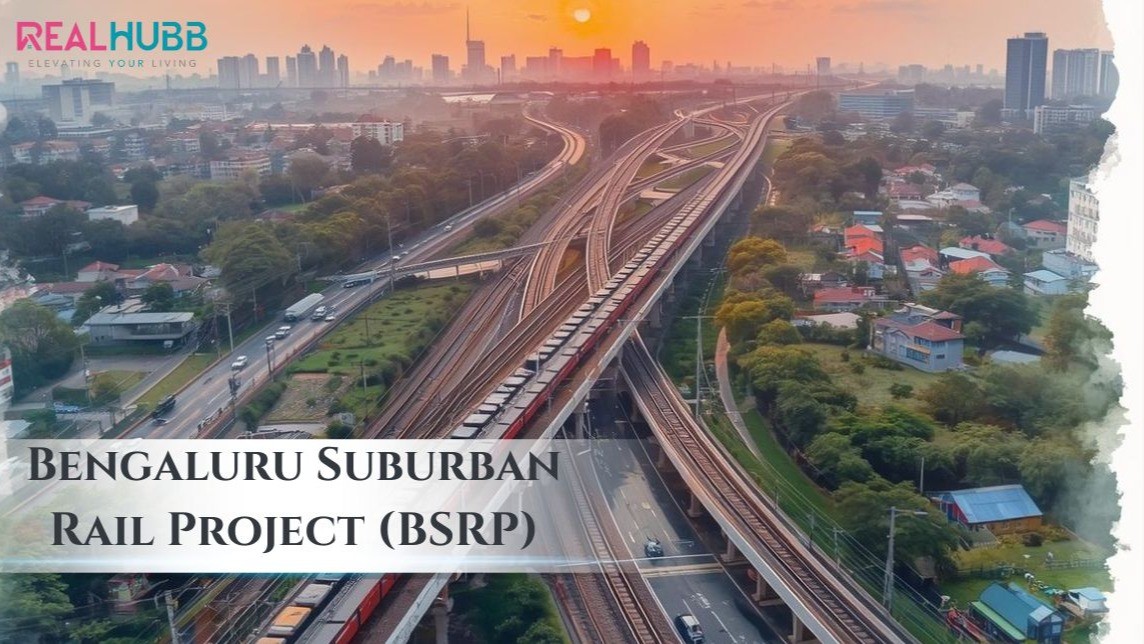
Bengaluru Suburban Rail Project (BSRP): A Game Changer for Property Buyers
The Bengaluru Suburban Rail Project (BSRP) is one of the most important infrastructure initiatives for the city’s future mobility and real estate expansion. Designed as a high-capacity commuter rail system, it aims to link core city areas with fast-growing suburbs through a dedicated network of corridors and stations.
What Is BSRP?
BSRP is a suburban rail network planned over approximately 149 kilometres, running across four main corridors named after flowers and serving 57 stations across the metropolitan region.
- Sampige Line (Corridor 1) spans around 41 km from KSR Bengaluru to Kempegowda International Airport, improving airport connectivity for daily commuters and flyers.
- Mallige Line (Corridor 2) runs about 25 km between Benniganahalli and Chikkabanavara, integrating eastern and north-western neighbourhoods.
- Parijaata Line (Corridor 3) covers nearly 36 km from Kengeri to Whitefield, connecting key residential and IT hubs.
- Kanaka Line (Corridor 4) stretches around 46 km from Heelalige to Rajanukunte, serving southern and northern suburban belts.
Trains are planned as air-conditioned services with speeds up to roughly 100 kmph, running at short headways during peak hours to handle large passenger volumes.
How BSRP Evolved Over Four Decades
The idea of a suburban rail system for Bengaluru has been discussed for over 40 years, undergoing multiple studies and proposals before work finally picked up.
- The first major transport survey recommending a rail system dates back to the early 1980s, when rapid urbanisation was just beginning.
- Different plans between 1993 and 2012 proposed networks ranging from around 204 km to more than 440 km, but they were delayed due to funding and coordination issues.
- Momentum increased after 2013, when the state government approved the concept and a dedicated entity, Bengaluru Suburban Rail Corporation Limited (BSRCL), was formed.
- The project received Union Cabinet approval in 2020 with a multi-thousand-crore budget, followed by a foundation stone ceremony in 2022.
Despite challenges like the pandemic, tender disputes, and land acquisition hurdles, work has now moved from planning to visible civil construction.
Current Progress and Timelines
As of late 2025, BSRP has moved into active execution mode, though full completion is expected to take a few more years.
- Overall project progress is around the high-teens in percentage terms, with the Mallige corridor showing the fastest headway and Kanaka in earlier stages.
- Construction includes viaducts, station structures, electrification, and signalling upgrades on sections shared with existing Indian Railways tracks.
- Depots are being developed at locations like Soladevanahalli and Heelalige to house and maintain multiple train sets.
- Initial expectations of full operations by 2026 have shifted, with realistic timelines now stretching toward 2027–2028 for complete network functionality.
While delays remain a concern, recent budget allocations and policy support suggest that execution speed is improving.
Impact on Real Estate and Daily Life
For homebuyers and investors, BSRP is more than just a transport project; it is a catalyst for new real estate micro-markets across Bengaluru.
- Suburbs along the corridors—such as Devanahalli, Heelalige, Whitefield, and Chikkabanavara—are expected to see stronger demand for 2 and 3 BHK homes in the mid-ticket segment.
- Property values near stations could rise significantly over time, similar to the appreciation seen near metro lines, especially where land is still relatively affordable.
- Daily commute times to office hubs like MG Road, Electronic City, and major tech parks are projected to reduce sharply for residents living near BSRP stations.
- Lower road congestion and reduced private vehicle usage can improve air quality and overall quality of life for city residents.
Developers are already eyeing station catchment areas for integrated townships, rental-friendly housing, and commercial developments that leverage high footfall.
Long-Term Vision and Phase 2 Potential
Beyond Phase 1, BSRP is expected to act as a backbone for wider rail-based connectivity around Bengaluru.
- Future expansion plans include additional corridors linking satellite towns and creating a more circular network for regional travel.
- Integration with Namma Metro, city buses, airport rail, and last-mile modes like e-bikes and feeder services will create a seamless multi-modal ecosystem.
- Smart stations are proposed with amenities like retail spaces, solar power, and digital services, adding both convenience and revenue streams.
For homebuyers, early investment along BSRP corridors could turn out to be a strategic move, combining lifestyle benefits with long-term capital appreciation.
RealHubb Editorial Team
Real Estate Expert · RealHubb Ventures
RealHubb Editorial Team is a seasoned real estate advisor at RealHubb, dedicated to helping families find their dream homes in Bangalore, Hyderabad, and Chennai.